





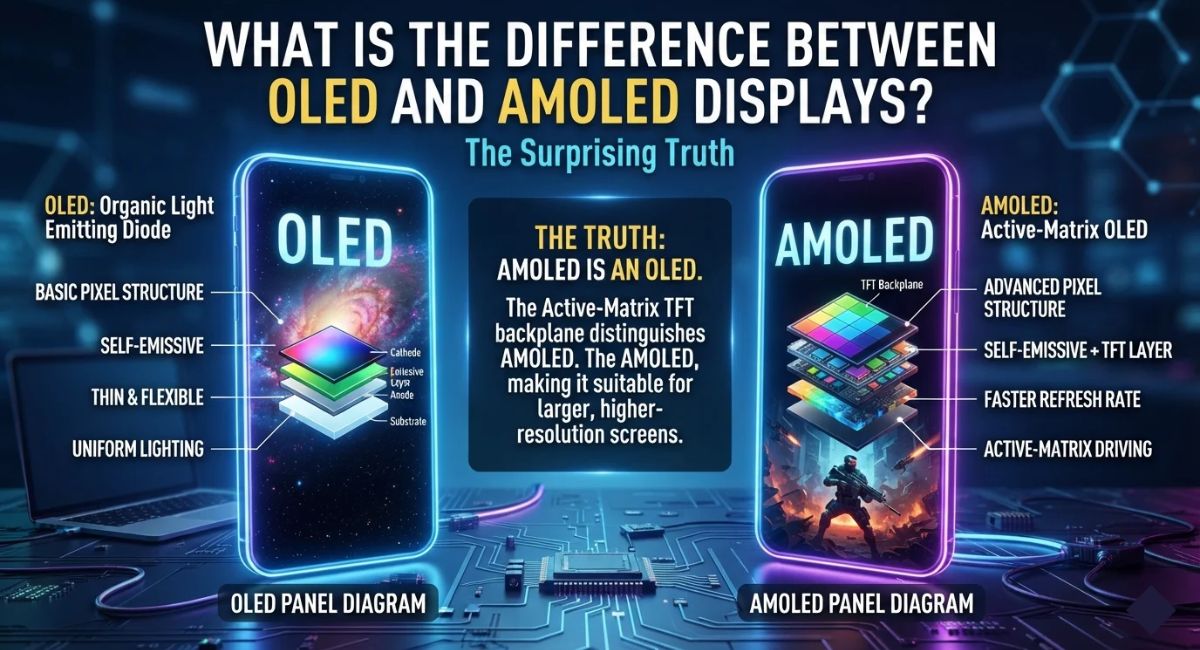

What’s the difference between OLED and AMOLED displays? It’s a question many shoppers have before purchasing a new phone, TV or monitor. Many retailers use the two terms interchangeably, making it difficult for the consumer to decipher which is which. Some shoppers assume AMOLED displays are new and improved displays, while OLED displays are inferior. This is not the case at all. The difference between the two displays is very minor. Active Matrix OLED (AMOLED) displays have an added feature to basic OLED displays. Each pixel is controlled by an attached transistor. In basic OLED displays, groups or rows of pixels are switched on or off at a time. The active matrix layer in AMOLED displays helps with a refresh rate, touch response, and vivid video. Because AMOLED displays require an added feature to control each pixel individually, they are more efficient, but more expensive to manufacture. OLED displays are more common in basic electronics, while AMOLED displays are in high end devices. With that being said, OLED displays still outperform LCD displays. Since this technology uses organic materials, they are subject to burn in. In this guide, we will go over the basics of OLED displays and how they work. We will go over where they are most useful and how to improve the burn in issue.
What Is OLED? Organic Light-Emitting Diode Technology Explained
To explain what is the difference between OLED and AMOLED displays?, let’s start with OLED. OLED stands for organic light-emitting diode. Each pixel on the screen is made up of a self-emitting light diode. Therefore, old LCD screens require a backlight. OLED does not. A thin layer of organic compound is sandwiched between two electrodes. When a current is applied, the layer glows, and when the current is removed, the pixel turns off. Thus, a true black can be produced and a high contrast ratio can be achieved. Now what is the difference between OLED and AMOLED displays when it comes to light? The answer is nothing at this level. Both use the same self-emitting organic material. Therefore, we need to look into how a screen controls each pixel. We will discuss that in the sections that follow.
You will find OLED displays in TVs, smartphones, smartwatches, tablets, laptops, and other portable devices. As there is no backlight, the panel is thin. A flexible OLED display can be rolled or folded. In addition, each pixel in an OLED display is self-illuminating. Consequently, OLED displays can turn off individual pixels, compared to LCDs. LCD displays have to turn off pixels by blacking out the entire backlight. This takes more power, therefore OLED is more power efficient compared to LCDs. Another benefit of OLED is that it can display true black. These properties of OLED make it great for displays showing a lot of blacks (high contrast) or dark scenes. This makes OLEDs especially great for displays where users can adjust to dark mode. Again, keep this in mind as it impacts what is the difference between OLED and AMOLED displays in real world usage.
What Is AMOLED? How Active Matrix OLED Displays Work
Active matrix organic light-emitting diode displays are known as AMOLED displays. It is OLED with one big add-on. That add-on is a thin-film transistor (TFT) backplane. Each pixel gets its own tiny switch and a storage capacitor. The switch tells the pixel when to light up. The capacitor holds that level until the next refresh. This is the first clue to what is the difference between OLED and AMOLED displays. Plain OLED is only the glowing layer. AMOLED is the glowing layer plus smart pixel control. Because of this, AMOLED can handle high resolution and large sizes.It also has a quick refresh rate. Remember only one thing about the difference between OLED and AMOLED displays? Remember this, AMOLED stands for active matrix control.
Brands add their own names to AMOLED. Super AMOLED puts the touch sensor inside the screen layer. This can improve sunlight readability and cut power use. Dynamic AMOLED is a Samsung Galaxy name for a high-end panel with HDR and a smooth 120Hz refresh rate. Many new phones also use LTPO backplanes. LTPO lets the screen change its refresh rate to save battery life. These names can add to the confusion about what is the difference between OLED and AMOLED displays. Here is the simple view. They are all AMOLED types. They are all OLED too. What is the difference between OLED and AMOLED displays? AMOLED is the improved version of OLED. AMOLED is also a technical term, and no company owns it.
Is AMOLED the Same as OLED? Active Matrix vs Passive Matrix Explained
Many people ask, is AMOLED the same as OLED? And how about OLED and AMOLED displays? The short answer is that AMOLED is a type of OLED. The other kind is PMOLED, or passive matrix OLED. PMOLED lights pixels one row at a time. This limits resolution and size. It works best on tiny screens, usually under about 3 to 5 inches. You see it in small gadgets. AMOLED uses active matrix control instead. Every pixel has its own transistor. So it can power large, sharp screens. Here is the key point about what is the difference between OLED and AMOLED displays. It is often a PMOLED versus AMOLED question, not a different technology.
Here is a twist. Many screens sold as “OLED” are also active matrix. Most high-end OLED TVs and monitors use a TFT backplane. So in many cases, there is no real gap. Some say “AMOLED” is partly marketing.What is the difference between OLED and AMOLED displays is most commonly asked by people when they see AMOLED displays on mobile devices. The term “AMOLED” is largely used in mobile displays and that is why the term “OLED” is not as popular as “AMOLED.” The specification sheet will always provide the exact details of the display panel. Peak brightness, refresh rate, and PWM dimming details can be found in the sheet. What is the difference between OLED and AMOLED displays should not be of great importance once you know the actual values. Panels with the same label can have a great difference in performance.
OLED vs AMOLED: Key Differences in Brightness, Refresh Rate, Battery Life, and Burn-In
Now let us compare them side by side. This is the heart of what is the difference between OLED and AMOLED displays. Treat “OLED” here as basic or passive OLED, and AMOLED as active matrix OLED. On brightness, AMOLED panels can reach higher peak brightness, so they work better in the sun. On refresh rate, AMOLED can hit 120Hz or more. Basic PMOLED cannot keep up with fast video. Response time and touch sampling rate are also better on AMOLED.This is important for things like gaming and smooth scrolling. The main difference between OLED and AMOLED for daily use is speed. The Response Time (the speed it takes to change a pixel from one color to another) is typically faster with AMOLED displays. Aside from speed, both provide true blacks and good color saturation.
Look at power efficiency, burn-in, and cost next. For power efficiency, AMOLED pixels only use power when they are being used to display an image, whereas PMOLED pixels waste power by constantly driving whole rows to display an image. Burn-in and image retention can happen on both types of displays if a static image is displayed for an extended period of time. This can be minimized by pixel shifting and using varied content on the screen. AMOLED is more expensive to manufacture than PMOLED because of the TFT backplane. However, AMOLED can be made big and sharp like 4K displays. So what is the difference between OLED and AMOLED displays in price? Simple PMOLED is cheaper. AMOLED costs more but does more. That is the final piece of what is the difference between OLED and AMOLED displays, and the table below sums it up.
| Feature | Basic / Passive OLED (PMOLED) | AMOLED (Active Matrix) |
| Pixel control | One row at a time | Each pixel has its own transistor |
| Best screen size | Small, under about 5 inches | Small to very large |
| Resolution | Low | High, up to 4K and beyond |
| Refresh rate | Limited | 120Hz or higher |
| Power use | Higher peak current | Efficient, pixel by pixel |
| Burn-in risk | Yes | Yes |
| Cost | Lower | Higher |
| Typical devices | Fitness bands, small panels | Phones, tablets, watches, TVs |
Which Is Better: OLED or AMOLED for Phones, TVs, and Gaming?
What is the difference between OLED and AMOLED displays? When it comes to smartphones, AMOLED is the way to go. The vivid colors and easy readability in direct sunlight make the display pop and get the user’s attention. Want a real-world example? See the Galaxy S26 Ultra vs iPhone 18 Pro Max comparison. For smartwatches, you can use either. While OLED smartwatches are cheaper and don’t drain battery as quickly, AMOLED smartwatches can display higher refresh rates. For TVs and monitors, you’ll find the label “OLED,” but many are active matrix. For gaming, look at the response time and input lag, as these will greatly impact your gameplay. For high refresh rates, OLED is the way to go. Look at the specs and read the reviews to see what is the difference between OLED and AMOLED displays. This will help you see the real differences between the displays.
Here’s a quick buyer’s guide. For a phone with a high refresh rate, good battery life, and striking colors, look for an AMOLED display. For simple, inexpensive displays to show text, look for OLED. The best OLED displays for high-quality picture are OLED TVs and QD-OLED monitors. Overall, OLED displays usually create deeper blacks than LCDs, IPS LCDs or Mini-LED displays. For what it’s worth, OLED offers better, higher quality displays, and brands like Samsung and LG dominate the market. Using this buyer’s guide, you will be able to find the true differences between OLED and AMOLED displays. Shopping will now be a breeze!
FAQ’s
Is AMOLED the same as OLED?
AM OLED is a type of OLED. The only difference is the addition of an active matrix layer (a TFT backplane) that adds control of each pixel using a transistor.
Which is better, OLED or AMOLED?
Generally, AMOLED is better for use in phones because it supports higher refresh rates and has a better battery efficiency than OLED. TVs and monitors, however, usually use the same panels for both OLED and AMOLED displays. Most so-called “OLED” displays are actually active matrix displays.
Does AMOLED have burn-in like OLED?
Yes, burn-in and image retention are possible on both. If you frequently show the same image on the screen for long durations, there is a higher chance of it happening. Showing varied content can help reduce the risk.
Is AMOLED better for your eyes than OLED?
Not necessarily. Both avoid backlights, but true eye comfort is more dependent on PWM dimming frequency and brightness settings than the label. High frequency PWM or DC-like dimming are better.



1 Comment
Apple Announces AppleCare Pricing for iPhone Duo: Hidden Costs
October 5, 2026[…] […]